Australian Mortality Data to August 2025 was released on 28 November 2025. Total Mortality to August down 1.1% vs 2024. Males Deaths 45-64, and all Folks Older than 65 had Highest Annual Peak in 2025.
Voluntary Assisted Dying Has Rising Uptake? Mean age of Completion ~74 across states, 1,424 completions in 2024-2025 (to June) up from 1,088 in 2023-2024, and 52 in 2019-2020, first year in effect.

ABS released Australian Mortality Data to August 2025 on 28 November 2025.

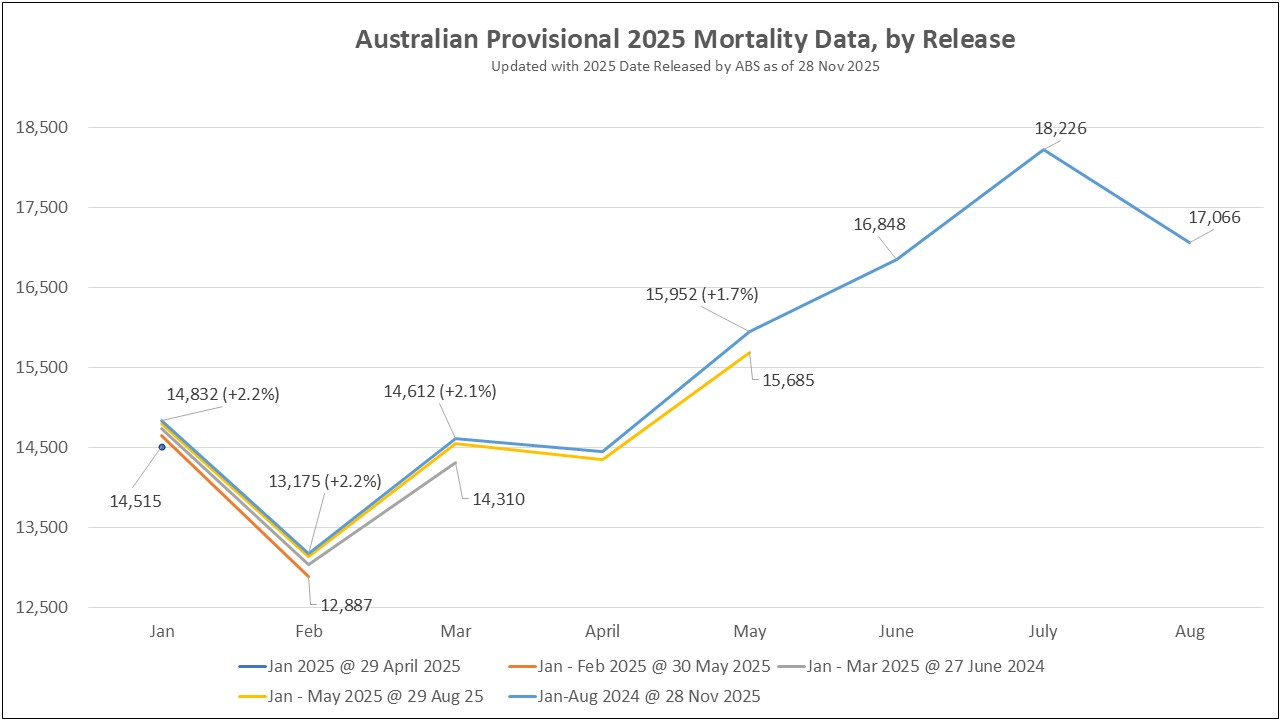
These data are still preliminary and will rise in the final count; historical rises are in the range of just over 2% from initial report to final death count reports.
Deaths are provided by week of death, up to week 35. Note that 2025 week 27 (June 30 - July 6), had peak highest ever recorded weekly deaths. Weekly deaths in 2025 to week 35 are 0.8% lower than 2024 weekly deaths.
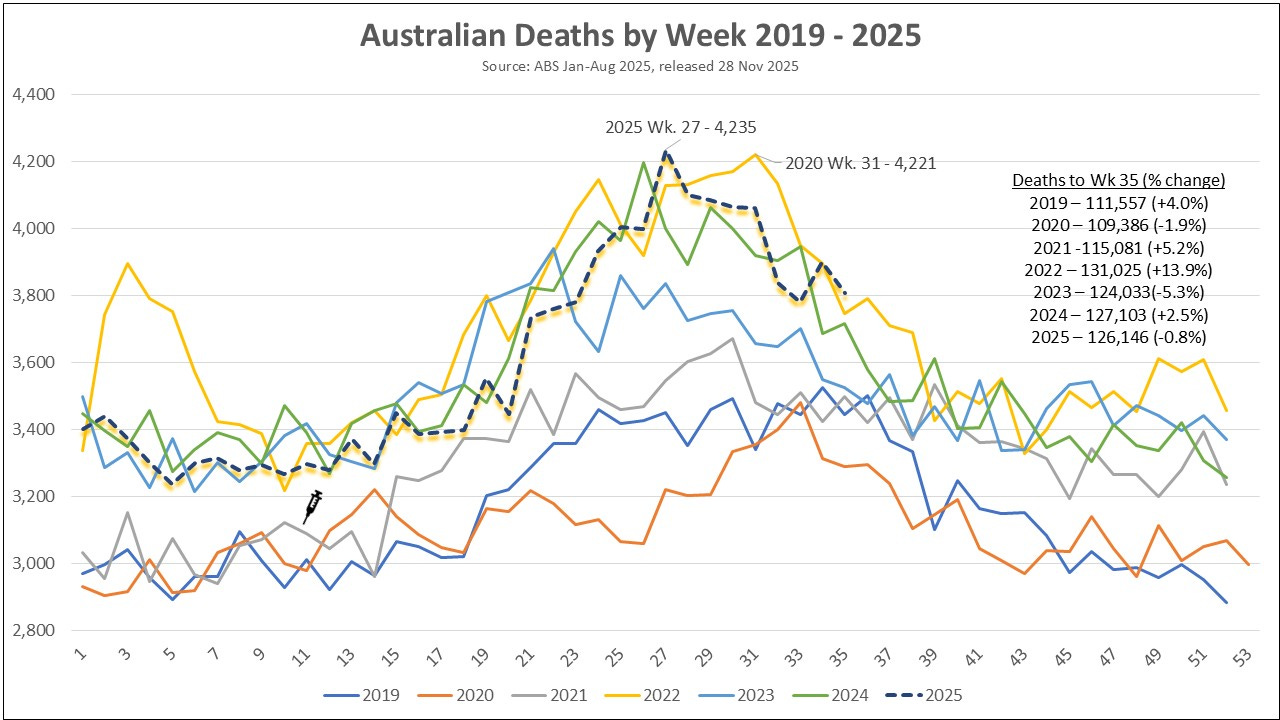
Patterns of weekly deaths are still running well above pre-2021 levels.
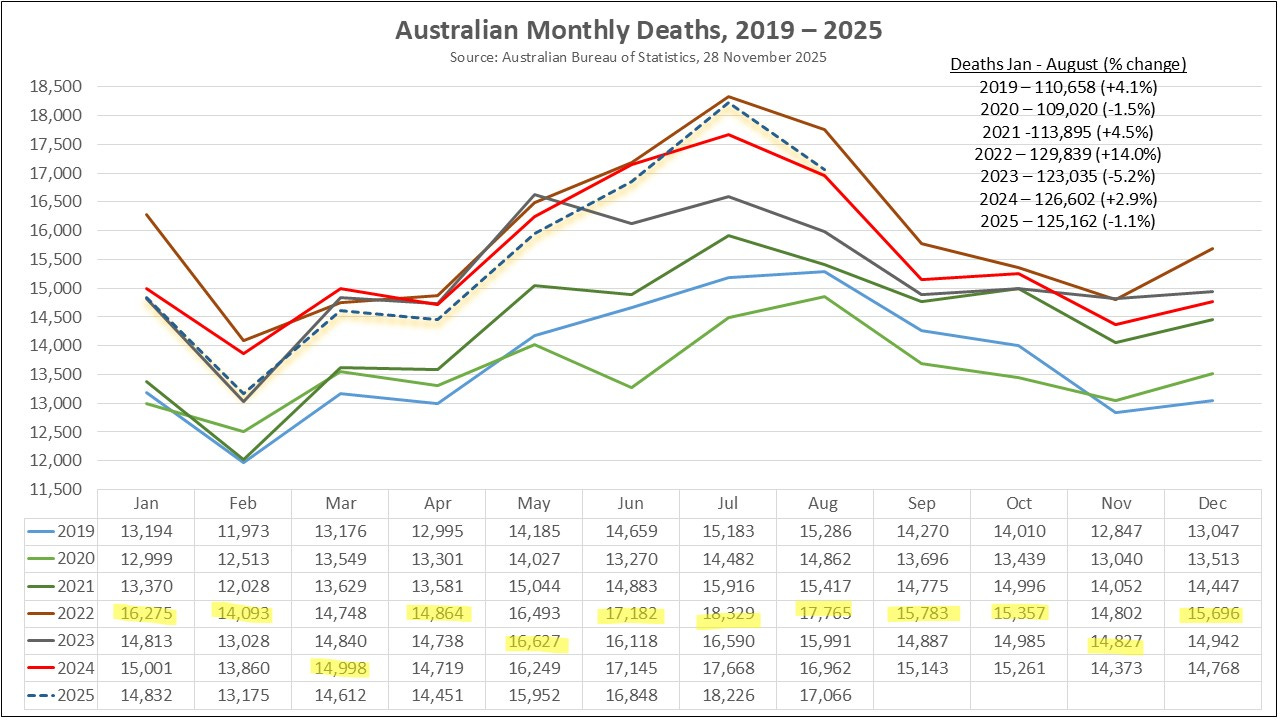
Deaths are also provided by month, with 2025 to the end of August being 1.1% lower than 2024 levels. All 2025 monthly deaths are lower than 2024 monthly deaths.
Deaths by gender still show the typical pattern of higher male than female deaths.
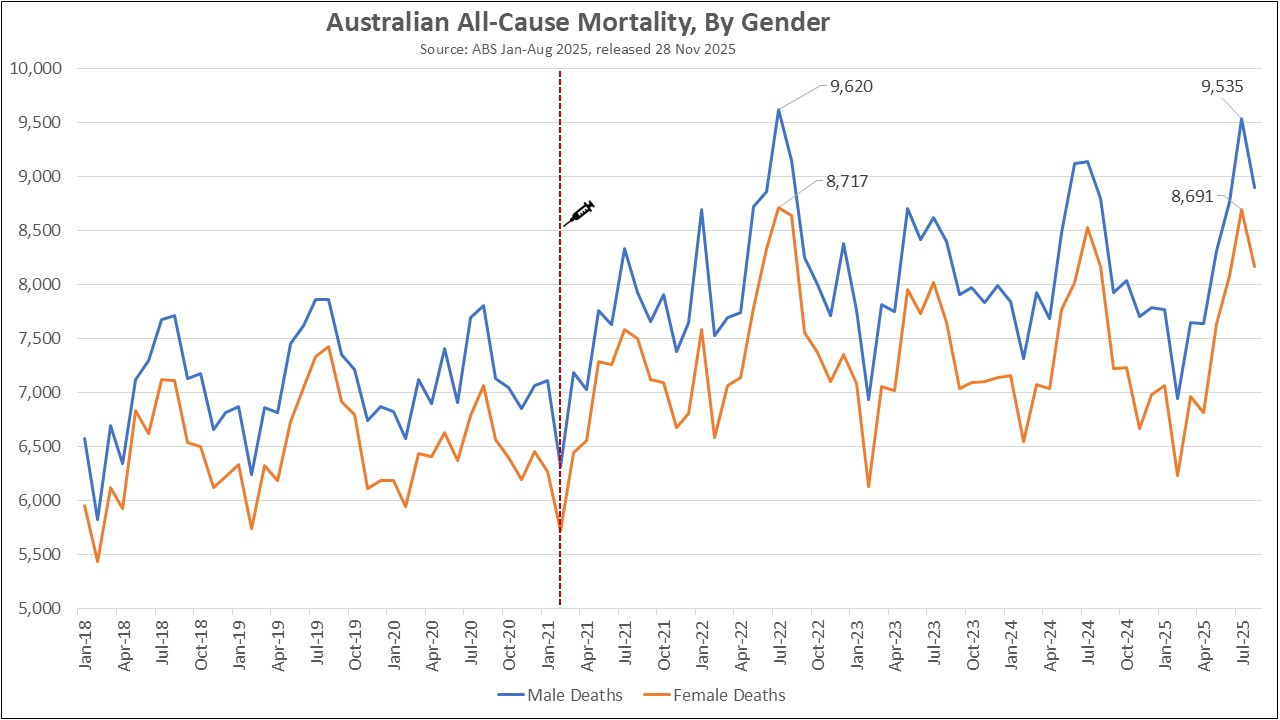
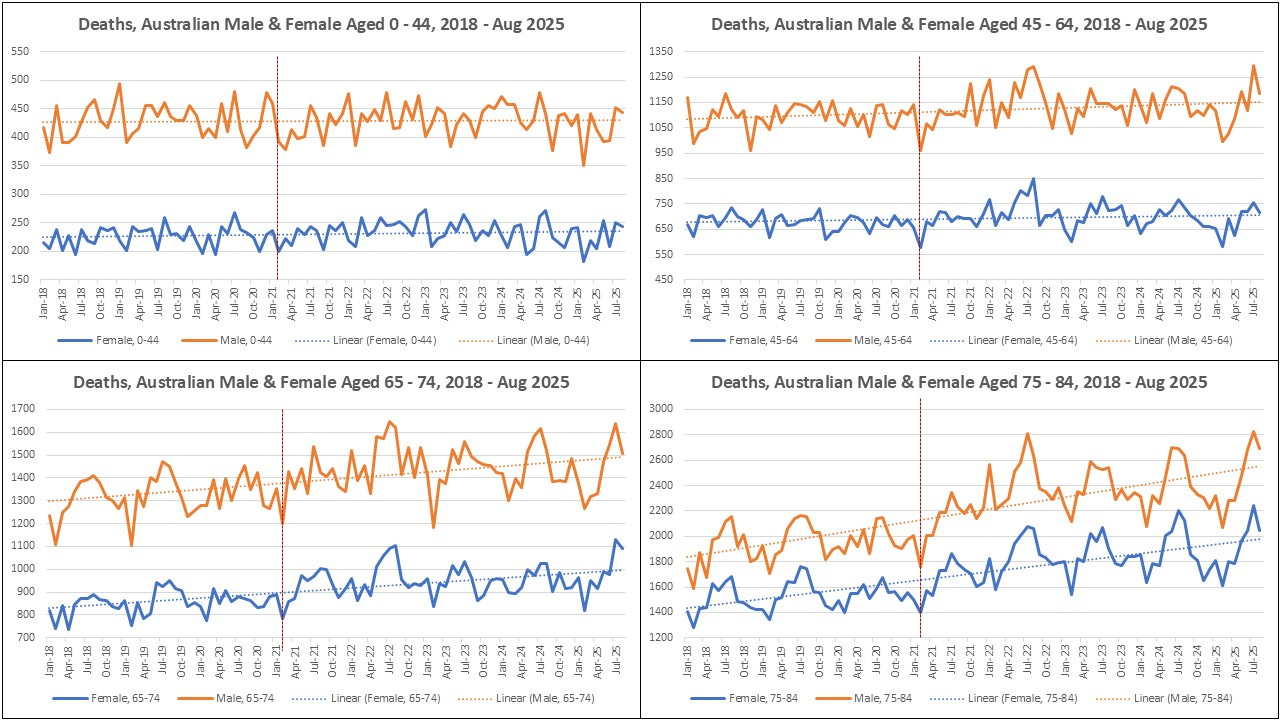
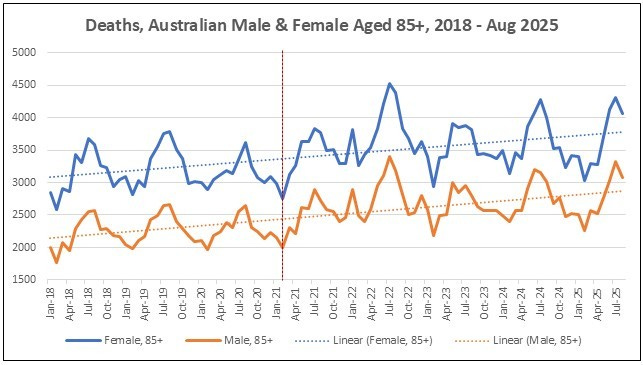
Death totals by age to August 2025 are lower than in 2024 except for persons aged 75-84, which are up by 0.2%, of which male deaths rose by 0.8% and female deaths fell by 0.6%, and in females aged 65-74, which rose by 2.1% (deaths in males aged 65-74 fell by 2.2%). The February 2021 rollout of COVID-19 Vaccines is marked by a red line.
IS VAD Contributing to Sustained High Mortality Levels?
With the rollout of Voluntary Assisted Dying (VAD) in Australia from 2019-2020, and slow ramp up to the present, the natural patterns of deaths may be expected to change.
VAD laws commenced in Victoria in June 2019, Western Australia (WA) in July 2021, Tasmania (TAS) in October 2022, Queensland (QLD), South Australia (SA), New South Wales (NSW) in 2023, and the Australian Capital Territory (ACT) in November 2025. The Northern Territory (NT) has no VAD laws as of December 2025. Wikipedia’s entry on Euthanasia and assisted suicide in Australia (updated November 2025) provides a timeline of laws across jurisdictions.
VAD completions (a cold word for the intentful ending of a life) have risen over time from 52 in 2019-2020, to 1,088 in 2023-2024 to 1,424 (est.) in 2024-2025 (partial to June 2025).
In 2023-24, VAD represents 0.5% of all deaths in VIC, ~1% in WA, and up to 1.6% in newer jurisdictions like NSW.
Western Australia’s Annual 2024 Report on VAD shows rapid increase in provision of this service and notes that “56% of reflections (n=20) received by the Board outlined issues regarding access to VAD”, with the Board making recommendations “to improve the safety1 and quality of VAD”. It appears that this method of dying, is set to rise in uptake in coming years!

An Australian contact shared her experience with VAD, where the mother of a close friend was hustled into end of life pathway (denied further treatment of chronic serious, but manageable health conditions, and died soon after) as soon as she began having challenges managing her health.
There is a very real risk that VAD becomes a death method of convenience and economy; as there are considerable savings in not having to care for people who are no longer independent and/or have high care needs. It may also be used to compensate for the lack of available and adequate medical care2; why treat someone when they can be encouraged to accept an earlier death. Why should life be hard or painful, if it can simply be ended! All life is ultimately terminal!
Authorities will certainly take the opportunity to avoid spending money who are no longer actively contributing to national coffers. Families may take the opportunity to receive inheritance earlier than they otherwise would have, without assets being drained by expensive medical / support care.
Why research and treat challenging health conditions, if those suffering from them can simply be convinced to end their lives with medical assistance.
Those having a bad day / week/month, may simply end their life without growing through the struggle of dealing with the lemons and worse thrown their way, denying themselves what might have been a brighter future and great contributions to the world. Isn’t it adversity and struggle that makes many of us better and stronger, and ultimately happier people? Is premeditated premature death, even from an ultimately terminal condition the best path3? Is there a soul cost to choosing to end life this way - for those accepting and those administering?
With society’s willingness to end life early for people who might need more support or care, we very much risk devaluing all life. VAD is a very slippery slope! We must evaluate and tread this precarious line very carefully indeed!
How can VAD be “safe” when the ultimate objective is to end a person’s life!
Waiting times for non-emergency medical care are very long. First appointments with psychiatrists can have 9 - 12 months waiting lists, medical specialists can have waiting lists of 6 or more months, even for people who have insurance and can go private [direct family experience]. Elective surgery waits can extend into years! In some remote rural areas, specialty medical care is not available at all.
This does not include those on their deathbed given pain killing meds that ultimately may shorten their remaining time.
Supper Sally, another ripper of a report.
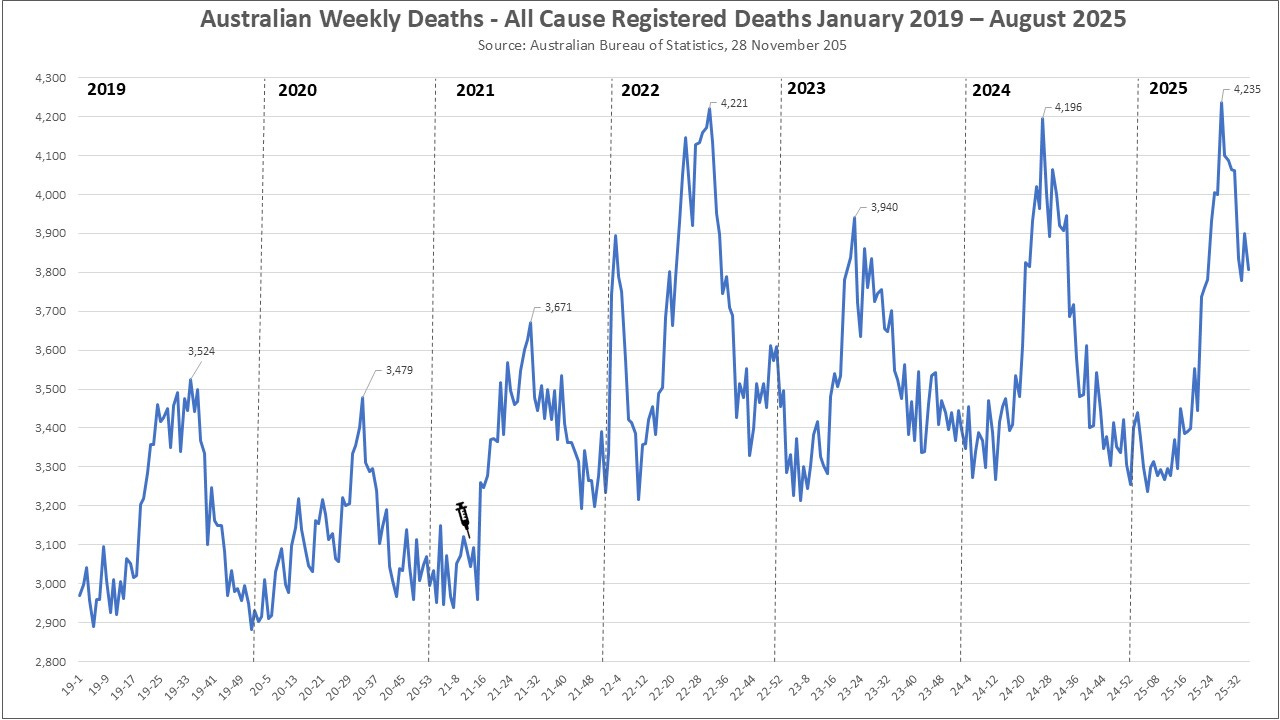
The Australian weekly deaths, Jan 19 - 2025 is an absolute eye opening window to how bad things really are. You totally nailed that graph. Great Job.
To those who are affected or being affected by this great deception foisted upon us from 2020, please enlighten others so this country can finally wake up. It's high time the politicians and bureaucrats that did this to us pay dearly.
Sally thank you so so much.
Can i please ask that you annotate your graphs so all credit come back to you alone.
Thankyou. I love the way you explain things. I am in WA. My husband has waited 18months to see a specialist. Procedure ordered. 3 months wait to procedure. Procedure stuffed up and results mysteriously lost in system. Back on waitlist. Compulsory 2% of income to Medicare contribution. Good one Australia.